- PlatformSolutionsResourcesContact UsClient Stories
- LoginRequest a demo

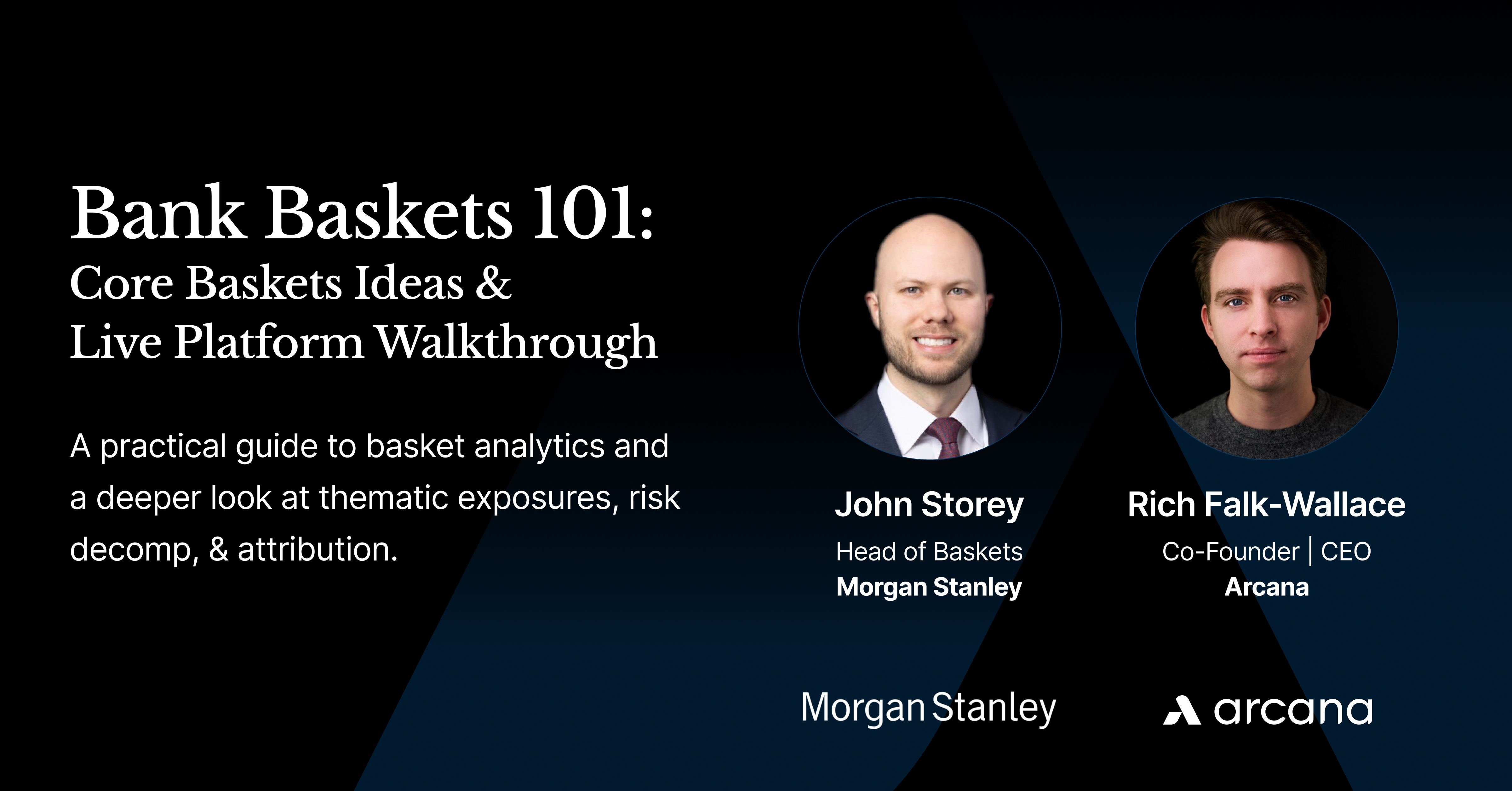
In our recent Bank Baskets 101 webinar, Arcana CEO and Co-Founder Rich Falk-Wallace joined John Storey, Head of Baskets at Morgan Stanley, to discuss how institutional investors are using bank baskets to navigate factor volatility, crowded trades, and increasingly complex portfolio risks. Here are the key takeaways from the discussion and live platform walkthrough.
In a market characterized by sharp rotations, crowded trades, and increasingly volatile factors, traditional index and sector hedges don't always provide the precision investors need.
According to Morgan Stanley's prime brokerage data presented during the webinar, hedge funds experienced more peak-to-trough de-grossing over the preceding two months than during any comparable period since the global financial crisis.
A key theme was the growing importance of exposures that cut across conventional sector classifications.
As Storey explained, sectors account for a declining share of portfolio risk, while thematic exposures have become increasingly significant. Investors can find themselves exposed to the same underlying theme—such as AI infrastructure—through companies spanning multiple sectors.
The challenge: Hedging with the S&P 500, Nasdaq, or sector ETFs may reduce broad market exposure without adequately addressing the underlying thematic risk.
Using Arcana, Rich walked through an illustrative AI-exposed portfolio constructed from publicly disclosed 13F holdings, comparing several potential hedging approaches.
The starting portfolio had approximately 27% modeled volatility, with significant exposure to AI and momentum factors.
Three approaches demonstrated the trade-offs:
These illustrative scenarios demonstrated how different basket constructions can produce materially different outcomes, even when addressing similar risks.
We can't necessarily eliminate thematic exposure, altogether, but we can distinguish between intentional bets and unintended risk and construct hedges accordingly.
Beyond selecting a basket, investors need to understand its underlying construction, including constituent exposures, diversification, factor sensitivities, and correlations.
Within Arcana, investors can evaluate these characteristics alongside their existing portfolios, compare potential hedges, model different allocations, and stress-test the results.
Performance attribution adds another dimension. By examining how factor and residual returns contribute to historical performance, investors can identify exposures that may not have been apparent from their original investment thesis.
This creates a direct connection between understanding past performance and making better-informed portfolio decisions.
While bank baskets have historically been associated with macro funds and market-neutral strategies, Storey highlighted growing adoption among fundamental long/short managers, long-only investors, and asset owners.
These investors increasingly use baskets to express thematic views, manage concentrated exposures, and implement hedges without relying entirely on individual securities.
The discussion also explored options on custom baskets, particularly as investors seek more convex protection against abrupt factor rotations and crowded-position unwinds.
The overarching takeaway: Effective hedging requires understanding not just what a basket represents, but how it interacts with the rest of the portfolio.
As thematic risk becomes more complex, investors need to evaluate basket exposures, compare hedging strategies, and understand their effects on portfolio risk and performance before putting capital to work.
Arcana connects these workflows in one portfolio intelligence platform, bringing together live risk analytics, performance attribution, scenario analysis, and portfolio construction.
Watch the full webinar for additional insights from Morgan Stanley and Arcana, including the live portfolio hedging walkthrough.
Watch the webinar recording here.

