- PlatformSolutionsContact UsClient Stories
- LoginRequest a demo


For the CIO of a global $1T+ asset manager, the challenge wasn't generating more research or hiring more investment talent. It was building the infrastructure that allowed fundamental, long-only investment teams to operate more effectively at institutional scale.
The firm already had systems for research, portfolio analytics, benchmarking, risk, attribution, and performance. But those systems operated independently. Understanding the complete picture—from an analyst's stock-level thesis to its contribution to portfolio performance—required moving between tools and manually connecting the dots.
The CIO realized the firm didn't have an information problem. It had an infrastructure problem.
For a large active asset manager, portfolio decisions are made relative to both fundamental conviction and a benchmark.
Portfolio managers need to understand active weights, factor exposures, concentration, tracking error, and sources of active risk alongside the fundamental research behind each position. Analysts need to understand whether their stock-picking and recommendations ultimately contribute to portfolio performance.
As the organization grew, much of that context remained distributed across teams, tools, and workflows. The challenge was to create a common foundation across the investment organization without forcing every portfolio manager or analyst into the same process.
The goal was straightforward: connect RMS with portfolio construction, benchmark-relative risk, and performance so investment teams could understand not only what they owned, but why they owned it and what was driving results.
The firm selected Arcana to connect these workflows rather than introduce another point solution. Arcana brought portfolio analytics, research, benchmark analysis, active risk, attribution, and performance into a shared investment workflow.
Portfolio managers could monitor active weights, tracking error, factor exposures, and concentration relative to their benchmark. Brinson attribution could decompose performance into allocation and selection effects, helping teams understand where active returns were actually coming from.
Research could then be evaluated alongside those portfolio outcomes, connecting fundamental stock selection and analyst conviction directly to performance.
Questions that previously required gathering information from multiple systems could now be investigated from one place. Arcana quickly became embedded in how investment teams operated day to day.
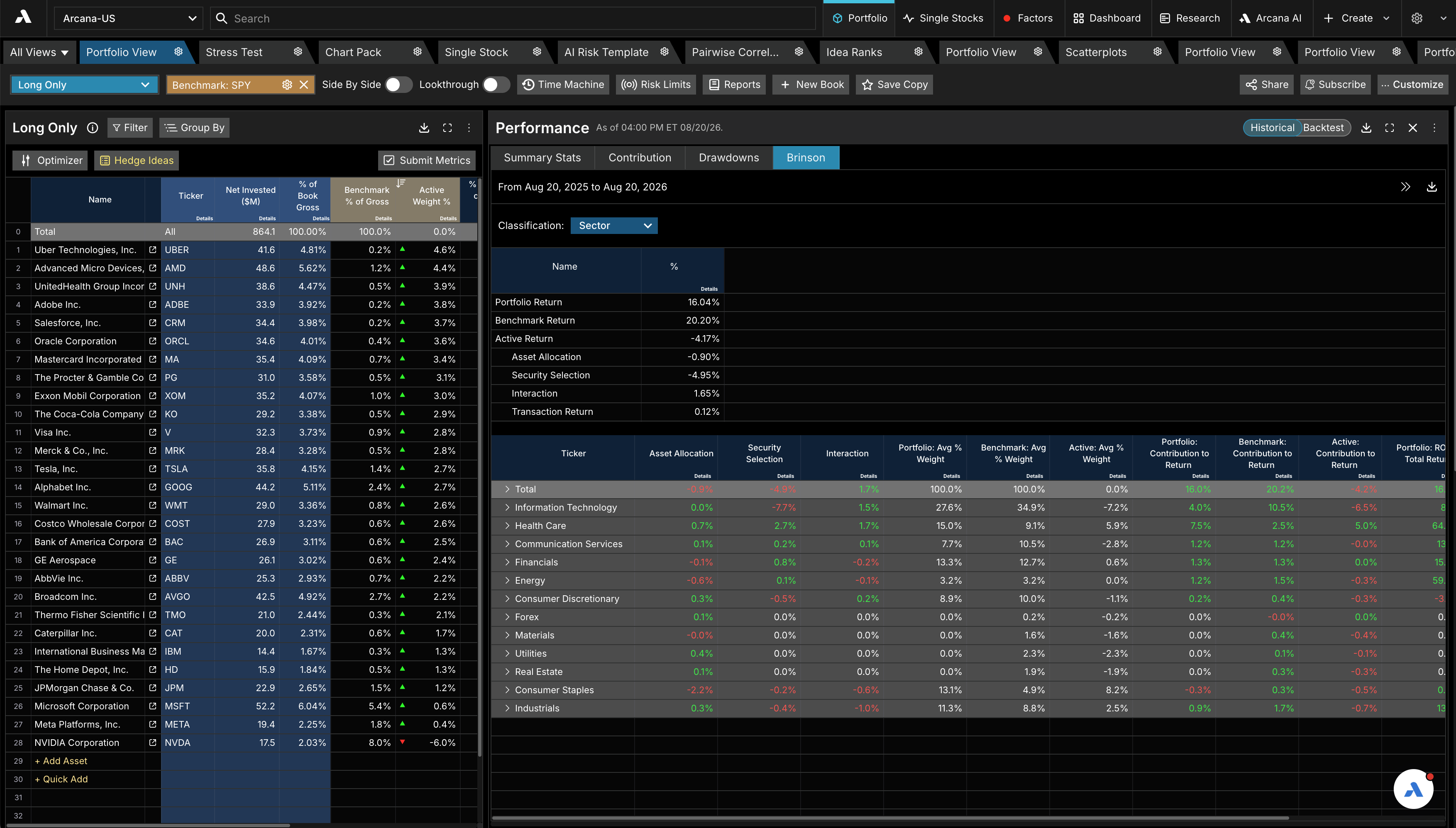
For the CIO, the value went beyond automation and efficiency. Arcana created a common foundation across investment teams while allowing individual portfolio managers and analysts to maintain the fundamental investment processes that made them effective.
Portfolio managers could understand the drivers of active performance and risk. Analysts could see how their research and stock-picking translated into portfolio outcomes. Investment teams could compare allocation and selection effects, investigate changes in factor exposure, and revisit historical investment decisions with the context around what the firm knew and believed at the time.
That changed the nature of investment reviews. Instead of spending time assembling benchmark, attribution, risk, and research context, teams could begin with a shared understanding of what drove performance and focus on the decisions that mattered.
Today, Arcana is part of the firm's daily investment workflow.
Portfolio managers can move from understanding portfolio performance to identifying the allocation, selection, factor, and stock-level decisions that drove it. They can evaluate active weights, concentration, tracking error, and factor exposures alongside the fundamental research supporting each investment.
Analysts can connect estimates, conviction, and long-term fundamental research to subsequent portfolio outcomes, creating a feedback loop between stock selection and performance.
Historical investment decisions remain available as context for new ones, allowing the firm's institutional knowledge to compound over time.
The result is less time assembling information and more time understanding the sources of active return and risk. For a global asset manager built around fundamental investing and long-term stock-picking, the objective isn't to replace investment talent. It's to give active investors better infrastructure.

